Stock Photos Are a Tell: Start Your Imagery With Your Own Pictures
You announced the second location with a photo of four people laughing around a laptop in an office with exposed brick. Nobody on your team is in it. The brick isn't yours. A regular customer saw it, scrolled past, and thought nothing in particular — which is the problem. That post did not make them picture your shop. It made them picture nothing.
Small and mid-sized businesses win on specificity. People buy from you because they know the van, the storefront, the person who shows up. Stock imagery erases exactly that advantage, and generic AI imagery does the same thing faster. If the picture attached to your offer could be attached to any competitor's offer, you have spent your best asset — being a real, local, known business — on a visual that says nothing.
Generic Imagery Undercuts the Thing You're Actually Selling
There's a moment in every campaign where the copy is fine and the image is a placeholder that never got replaced. It happens because good photography is slow. A shoot takes scheduling, a photographer, a decent day, and a team that is willing to stand still. Most businesses do it once every few years, then ration those forty usable frames across email headers, social posts, the website and the print flyer until everyone on staff is sick of the same picture of the counter.
So the placeholder wins. And the placeholder is anonymous. Over a quarter of campaigns, the cumulative effect is a brand that looks like a template — polished, plausible, and completely interchangeable. Meanwhile the photos on your phone show the actual crew, the actual equipment, the job site at seven in the morning with real light on it. Those are the assets. They are just not in a shape you can publish.
Your Photos Are the Reference, Not the Final Draft
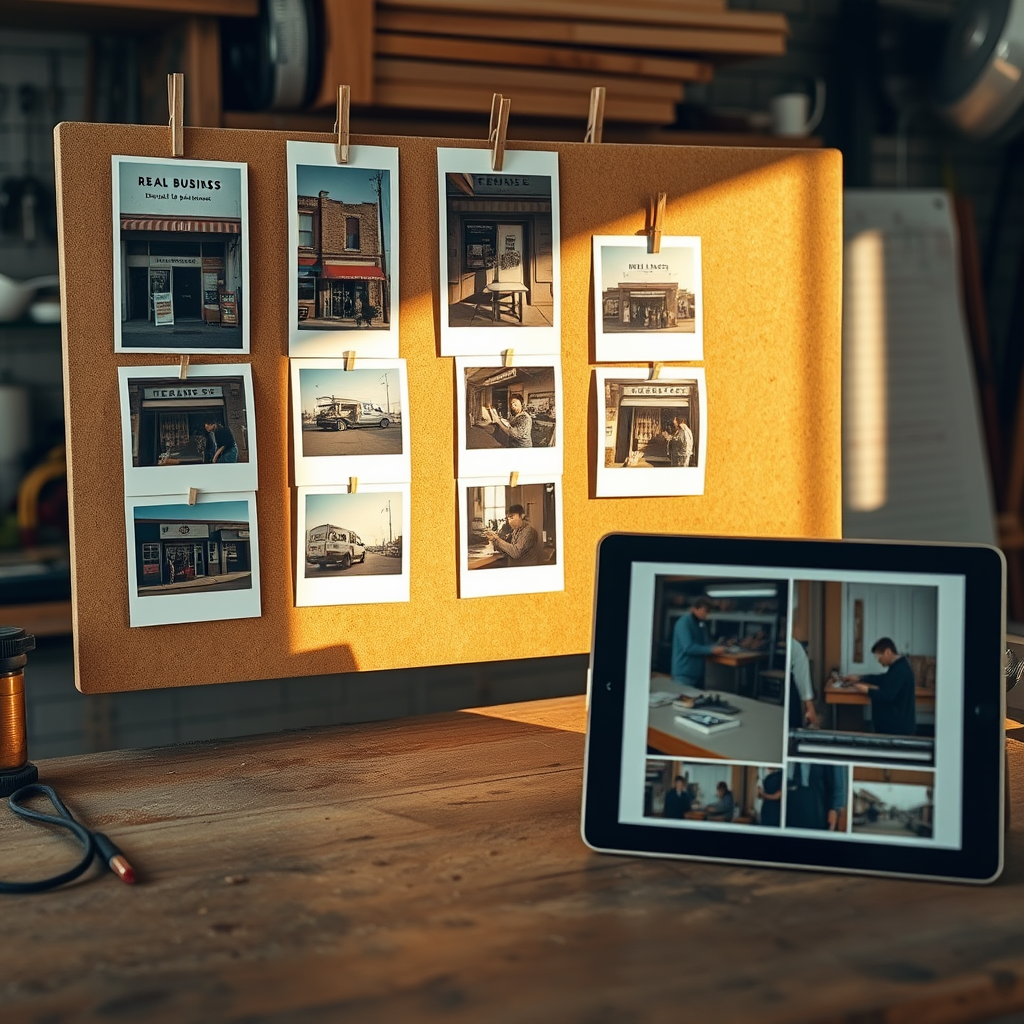
The useful shift is treating your existing pictures as reference material rather than finished output. Growth7's content studio takes customer photos as reference input, which means the imagery it generates carries your actual subject matter — your space, your products, your people — into scenes and compositions you never photographed.
That changes the economics. You don't need a shoot for every campaign; you need a reasonable set of source photos and a clear idea of what the campaign is about. The blurry phone shot of the workshop becomes the basis for a clean hero image. The single good photo of the new product becomes a seasonal promotion, a testimonial background and a blog header that still look like the same product in the same world.
A few habits make the reference library worth having:
- Shoot your real environment on a normal day rather than a staged one — the specifics are what make it recognisable.
- Capture the same subject from more than one angle and distance, so there's something to work from.
- Keep the people who actually appear in front of customers in the frame.
That's it. No production budget, no location scout. Just a deliberate half hour with a phone, repeated when something in the business visibly changes.
One Idea, Every Shape It Needs to Be
The second reason imagery stalls is mechanical. A square post, a vertical story, a wide email header and a blog hero are four different crops, and cropping a single image to fit all of them usually decapitates somebody. So the social post goes out with the right image, the email goes out with a stretched version of it, and the blog gets whatever was left over.
Generating in every channel aspect ratio from the start removes that decision entirely. The campaign has one visual idea, and each channel gets a version composed for its own frame instead of a compromise cut from someone else's. On a platform where email, SMS, voice and social run against one audience, that coherence does real work — the same person may see the story, open the email and later read the blog post, and all three should feel like one company talking, not three vendors.
The goal isn't cinematic imagery. It's imagery that is unmistakably yours, produced fast enough that you never reach for the stock library again. Your customers already know what your business looks like. Show them that.